
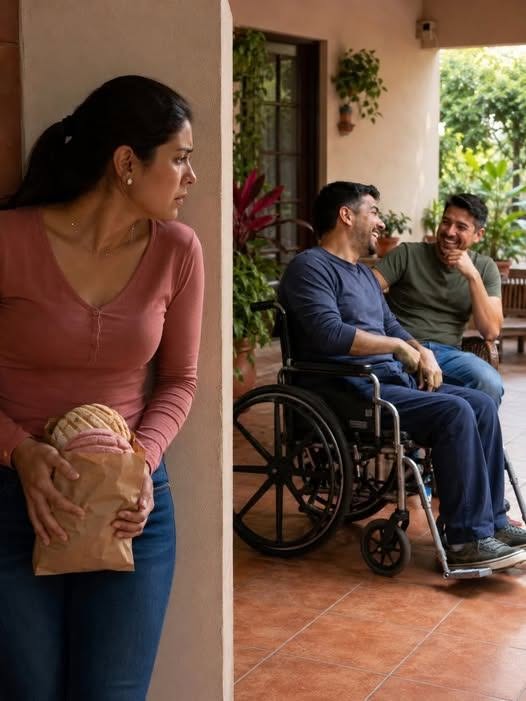
Not from pain.
From disgust.
That night, while I was feeding him dinner, Esteban asked me:
“Why are you so quiet?”
I wiped the corner of his mouth with a napkin.
“I’m tired.”
“Well, rest when I go to sleep.”
He said it shamelessly.
Like a boss.
Like an owner.
I smiled.
“Yes, Esteban.”
He didn’t notice anything.
Men like him never notice when a woman stops loving.
They only notice when she stops obeying.
For two weeks I continued as before.
I made him soup.
I changed his sheets.
I took him to therapy.
I smiled in front of the nurse.
And at night, while he slept, I made copies.
Audio recordings.
Bank statements.
Messages.
I recorded Tomás saying to me:
“When my father dies, you’re getting out of this house.”
I recorded Esteban replying:
“Leave her. As long as she’s useful to me, she can stay.”
I got a lawyer.
A good one.
One of those who don’t just pat you on the back, they open your eyes.
When I laid everything on her desk, she just said:
“Brenda, your husband doesn’t need a nurse. He needs a lawsuit.”
That Friday I came home early.
Esteban was in the living room, talking on the phone with Tomás.
He didn’t hear me come in.
“Don’t worry,” he was saying. “As soon as I’m gone, I’ll kick her out. The house is yours.”
I stood behind him.
And for the first time in five years, I didn’t feel sadness.
I felt peace.
I turned off the blender that was whirring in the kitchen.
Esteban turned around.
His smile faded.
“How long have you been there?”
PART 2
“Since ‘while it’s serving me.’”
Esteban froze.
The phone was still pressed to his ear. On the other end, Tomás asked:
“Dad? What happened?”
I walked over to the table, put my bag down, and looked at my husband.
At the man I had bathed for five years.
At the man who had watched me stop buying clothes, stop going out, stop sleeping, stop existing.
“Hang up,” I told him.
Esteban tried to smile.
“Brenda, you’re misunderstanding.”
“Hang up.”
I didn’t raise my voice.
That’s what scared him.
Tomás kept talking.
“Dad, is the lady there?”
Esteban hung up.
“I don’t know what you heard, but—”
“I heard enough.”
I approached him slowly.
The wheelchair was by the window. The room smelled of clean diapers, disinfectant, and vegetable soup. The television was on, muted, showing a game show where everyone was clapping as if life were fair.
“Brenda, don’t start with the drama.”
I laughed.
A small laugh.
Dead.
“Five years cleaning your body and you still think my pain is drama.”
His face changed.
“You chose to stay.”
“Yes. And today I choose to stop being of service.”
The color drained from his face.
“What does that mean?”
I took a folder out of my bag.
He recognized it immediately.
The gray folder.
The one I kept in the bottom drawer of the closet, behind some old blankets.
“Where did you find that?”
“In my house.”
“It’s my private documents.”
“No. It’s proof that while I was fighting with the IMSS (Mexican Social Security Institute) for your therapies, you were sending money to Tomás, hiding accounts, and plotting to kick me out of the house I’ve been supporting for five years.”
Esteban tightened the wheels of his chair.
“You can’t do this to me. I’m your husband. I’m sick.”
“You’re not sick in your tongue.”
I placed a piece of paper in front of him.
“I didn’t sign this power of attorney.”
He stared at the paper.
He didn’t blink.
That’s when I understood that he didn’t just know.
He had ordered it.
“It was to protect you,” he said.
“Forging my signature was protecting me?”
“You didn’t understand legal matters.”
“No. You prayed I never would.”
The door opened without a knock.
Tomás walked in as usual, wearing a cap, expensive sneakers, and looking like he owned the place.
“What are you doing to my dad?”
CONTINUED ON THE NEXT PAGE.


