
I let her enter.
Emma was coloring at the kitchen table.
Brooke crouched several feet away.
She didn’t touch her.
“Emma, I did something wrong at Sophie’s party.”
Emma looked at me.
I nodded.
Brooke continued.
“I should not have taken Mr. Buttons.”
Emma hugged the rabbit.
“And I definitely should not have grabbed your wrist.”
Brooke swallowed.
“I was wrong.”
Emma remained silent.
Then Brooke said the most important part.
“You do not have to forgive me because I apologized.”
I looked at her.
That surprised me.
Emma eventually whispered, “Okay.”
Brooke nodded.
“And you never have to hug me if you don’t want to.”
Emma thought for several seconds.
Then she asked:
“Can I show you my drawing?”
Brooke’s eyes filled with tears.
“Yes.”
That wasn’t forgiveness.
It wasn’t instant reconciliation.
But it was a beginning.
Later, Brooke told me why she had changed.
Sophie had asked her a question after the party.
“Mommy, if I say no to somebody, can they grab me too?”
Brooke said the question destroyed every excuse she had made.
She realized she had been teaching both girls something dangerous.
That adults could override their boundaries if they believed their reason was good enough.
Brooke started therapy.
My parents changed too.
Slowly.
Dad stopped smoothing over conflicts.
Mom began apologizing without adding “but.”
And I learned something about myself.
For years, I had tolerated family behavior I would never tolerate from strangers.
I called it keeping the peace.
But peace that requires one person to stay uncomfortable isn’t really peace.
Six months later, Sophie came to our house for Emma’s birthday.
When Emma opened her gifts, Sophie noticed Mr. Buttons sitting beside her.
“Can I hold him?”
Emma hesitated.
Then shook her head.
“No.”
I watched Brooke.
She smiled at Sophie.
“You heard her.”
Sophie shrugged.
“Okay.”
Then they ran outside together.
That tiny moment meant more to me than any dramatic apology.
Nobody cried.
Nobody argued.
Nobody demanded an explanation.
A five-year-old said no.
And the adults simply respected it.
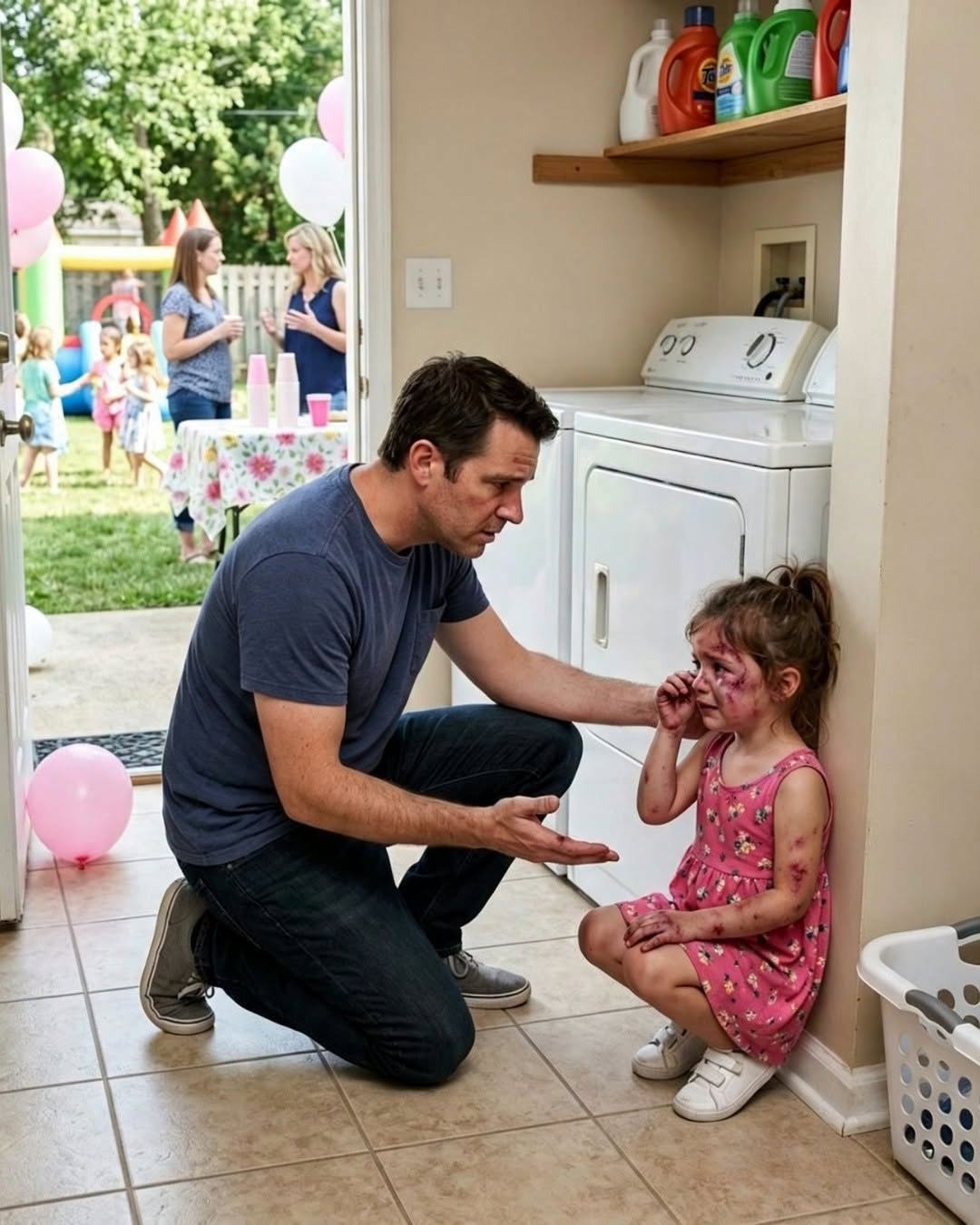
Sometimes I still think about finding Emma behind that washing machine.
Her knees against her chest.
Her rabbit squeezed against her body.
Her tiny voice asking whether she needed to apologize.
At five years old, she had already begun wondering whether keeping other people happy mattered more than her own comfort.
That terrified me.
But something good came from that afternoon.
Our family finally confronted a pattern that had existed for decades.
Brooke learned that authority does not make every decision correct.
My parents learned that avoiding conflict can become a form of choosing sides.
And I learned that my job wasn’t to teach Emma to keep adults comfortable.
My job was to teach her that her voice mattered.
Today, if Emma doesn’t want somebody touching her belongings, she says so.
If she doesn’t want a hug, she says no.
If something frightens her, she tells me.
And whenever she asks whether she is allowed to have boundaries, my answer is always the same.
Yes.
Even with relatives.
Even at birthday parties.
Even when somebody becomes disappointed.
Especially then.
Because the most important lesson my daughter learned that afternoon wasn’t how to share.
It was that love doesn’t require surrendering every boundary to keep someone else happy.
And the most important lesson our family learned was even simpler.
When a child says no, the adults in the room should be the first people willing to listen.


