
Solmera. Then Tazir. Then eight years as a consular duty officer, which is the job where you are the person the phone rings through to at three in the morning when a Norhaven national is in a cell, or a hospital, or a police station with no passport in a country they cannot pronounce.
He retired in 2021. He grows tomatoes now and is extremely boring about them.
And when I said the greenhouse is open, a man who had spent three decades doing exactly this picked up a pen.
In eleven minutes he had: rung the consulate in Porto Sella and spoken to somebody he had trained in 2009; established that an emergency travel document could be issued the same day if I could get to Porto Sella; and worked out — this is the part I did not think of, because I was in a dressing gown — that I should not get on a plane yet.
“Elise. Listen to me carefully. Before you leave that hotel, we need everything that hotel has.”
What the hotel had.
This is where Núria comes back in.
By the time I came down the second time, she had already done it. On her own. Before anybody asked her.
She had photographed both notes, in situ, with the room number visible.
She had printed the checkout record: 04:51, three guests departed, one remaining.
She had printed the car booking, made from the room at 23:40 the previous night, for 04:30, to Porto Sella airport.
And she had printed the itinerary changes on the room’s linked booking, which showed my return flight cancelled at 16:14 on the eleventh of June.
And she had photographed the contents of the safe, which was open and empty, and the safe’s own access log, which showed it opened at 04:22.
When I asked her why she had done all that, she said something I think about at least once a week.
“Because in four years here, madam, this is the third time. The other two women had nothing. Nobody believed them.”
And the two days, which people imagine as a chase and which were mostly queuing.
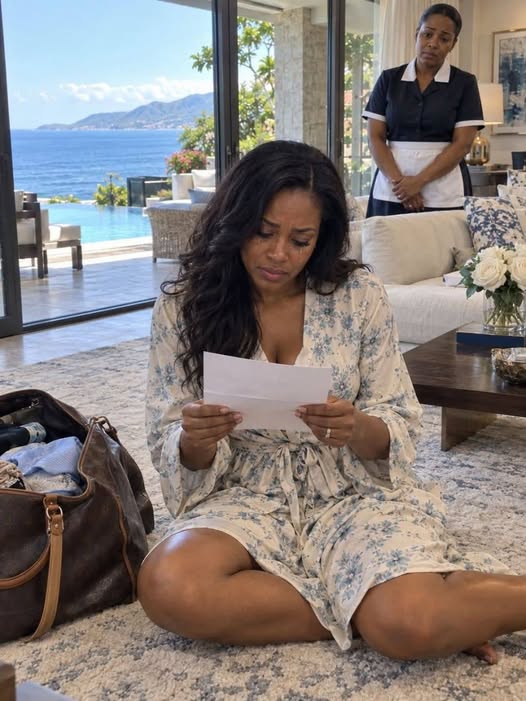
I did not have shoes. That is the detail nobody believes. I had gone down to reception barefoot and then I had never gone back up for anything except the notes, because I could not be in that room.
A cleaner called Inma gave me a sundress and a pair of espadrilles from the staff lost property, both a size too big, and would not take anything for them.
I was at the national police station in Porto Sella at half past ten. I was there for four hours. I gave a statement through an interpreter on a telephone. The officer was neither kind nor unkind, and he typed everything twice, and at the end he printed it and stamped it and gave me a copy, and that piece of paper with a time on it is the reason the rest of it worked.
The consulate was forty minutes and a woman called Marguerite who had been trained by Ronan in 2009 and who said ah when I said his name.
And then a night in a hostel near the port that the consulate found, in a room with five other people, where I lay on a top bunk with a stranger’s rucksack under my head and did not sleep at all.
I had eleven crowns. Inma had put them in the pocket of the dress.
What Ronan did.
He did not fly out. He told me on the phone that a seventy-one-year-old man appearing in Velmara would be a comfort and not a plan.
What he did instead, from a kitchen table in Ludworth, over about nine hours:
He talked me through the consulate. He told me exactly what to say and, more importantly, what not to say — not my husband has stolen my daughter, which makes you sound frantic, but I am a Norhaven national whose passport has been removed and I need an emergency travel document to return to my habitual residence.
He got the number for the police station in Porto Sella where you report this properly, and told me to go there before the consulate and not after, so that the report had a time on it earlier than everything else.
He told me the word. The word I did not know and which changed the whole shape of it.
The convention.
“Elise. Caldeira and Norhaven are both parties to the 1980 international convention on child abduction. Your daughter’s habitual residence is Ashcroft. She has been retained in Caldeira without your consent. This is not a custody dispute. It is an abduction application and it goes through a central authority, and it is fast, and you do not need money for it.”
You do not need money for it.
I was standing in a police station in Porto Sella in a sundress I had borrowed from a hotel cleaner, and a retired civil servant three thousand kilometres away told me that the thing they had stripped me of — money — was the one thing I would not need.
Why they did it.
Because in the March I had been to see a solicitor.
One appointment. Forty-five minutes. About separating.
I had not told anybody. I had not told Adrián. I had paid cash so it would not be on the card.
And I had made the appointment from my phone. Which my mother-in-law had been into, I found out later, at least four times over two years, using a passcode she had watched me type at a dinner table.
Pilar had seen a calendar entry that said M.K. 11am and had made it her business to find out what M.K. was.
And then there is the date on the bookings, which is the part that still makes me cold.
Pilar’s flight to Encarra with Mila was booked on the first of June.
Eleven days before.
Adrián’s was booked at 16:12 on the eleventh. Two minutes before my return was cancelled.
Eleven days versus two minutes.
She planned it. And she brought her son in the afternoon before, and he went along with it, and he cut his daughter’s chicken up at dinner that night with my cancellation already in his email.
I do not offer that as a defence of him. I offer it as an accurate description of both of them.
What happened.
I was back in Ashcroft on the Saturday. Two days. Emergency travel document, a flight Ronan paid for and would not discuss, and a police report with a time on it from Porto Sella.
The application went in on the seventeenth of June.
Mila came home on the eighth of August.
Fifty-seven days.
I am not going to describe them. I have tried three times and it will not go into sentences. What I will say is that Ronan rang me every evening at seven for fifty-seven days, and on about forty of those calls we talked about tomatoes.
The Caldeiran court ordered her return. It took the two notes about eleven seconds. The judge, I am told, asked Adrián’s lawyer to read the second one aloud — let’s see who comes and saves you now — and then asked him what he would like to say about it.
Apparently he said nothing at all.
And the fifty-seven days, which I said I would not describe, and one hour of which I will.
There were video calls. Twice a week, court-ordered, from the twenty-ninth of June.
Twenty minutes each. A tablet propped on a table in Encarra. Pilar always in the frame, always just at the edge, always reading a magazine.
And Mila, four years old, being extremely good.
That is what I was not ready for. She was not distressed. She was polite. She showed me a toy. She said yes and no.
And on the eleventh call, at about minute fourteen, she leaned right up to the camera so her face filled it, and whispered:
“Mummy. Are you allowed to come?”
Not when are you coming. Am I allowed.
Somebody had explained my absence to a four-year-old in a way that made it a matter of permission.
And I said yes, darling. I’m allowed. It’s just taking a while.
And she nodded and sat back and showed me the toy again.
CONTINUED ON THE NEXT PAGE.


