
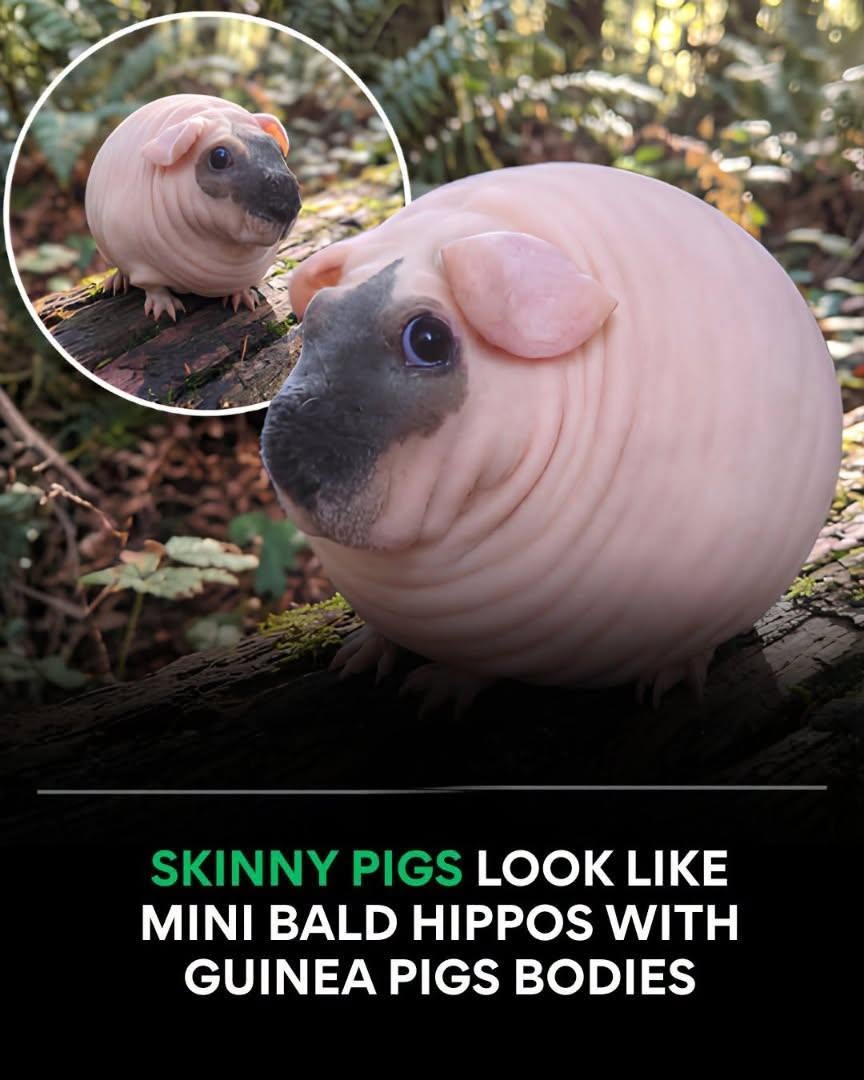
The resemblance to a baby hippopotamus is particularly striking when the animal is photographed from the front or side.
A baby hippo has a rounded body, small ears, short legs and folds of skin that make it look both powerful and adorable.
The Skinny Pig shares several of those visual characteristics, although it is obviously much smaller and belongs to a completely different animal family.
Its little face is perhaps its most charming feature.
The eyes are often dark and expressive. Its nose may have a slightly rounded appearance, and the tiny whiskers around its muzzle create an interesting contrast with its bare skin.
When it moves, its body can appear almost like a miniature creature from another planet.
Yet the Skinny Pig is very much a guinea pig.
It has the same basic body structure and many of the familiar behaviors associated with domestic guinea pigs.
It can explore its surroundings, communicate through squeaks, search for food, interact with companions and form strong associations with familiar people.
The most obvious difference is simply what is missing.
Its coat.
And that missing coat changes almost everything about the way people need to care for it.
2. THE SURPRISING GENETIC STORY THAT BEGAN IN CANADA
Santa Barbara Skinny Pigs
sbskinnypigs.com
The Skinny Pig did not originate from an ancient wild population of naturally hairless guinea pigs roaming through the forests of South America.
Its unusual appearance is associated with a genetic mutation.
According to the history commonly cited for the variety, the hairless trait was first identified in Canada in 1978.
This discovery helped establish the foundation for the development of the Skinny Pig as a recognizable variety of domestic guinea pig.
The genetic change affected the animal’s ability to grow a normal coat of hair.
In ordinary guinea pigs, hair follicles produce the coat that covers most of the body. That coat serves several important purposes, including insulation and protection from the surrounding environment.


